David B. Katague is an online memoirist and cultural essayist whose writing has appeared on HubPages

Saturday, November 2, 2024

My Childhood Experiences During the Japanese American War in the Philippines

This is the last article on my series about the Philippines in connection with the Filipino American History Month Celebration here in the US.
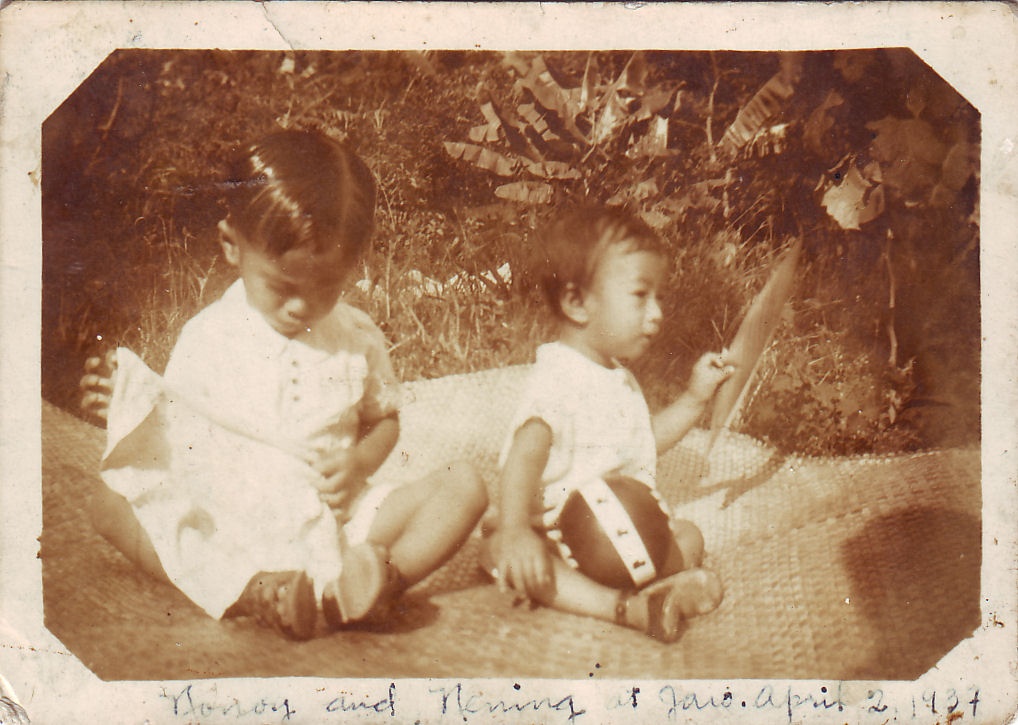
Erico (RIP- my younger brother) and Me, April 2, 1937, Jaro, Iloilo City, Philippines

As planned in connection with the celebration of the Filipino-American History month, I am reposting my article on my childhood experiences during the Japanese-American War in the Philippines. This posting is also Chapter 1 of my autobiography. It won a $100 writing award on Creative Writing Contest previously. 

This award inspired me to start blogging in 2008-2009. I have been blogging since. I am enjoying this activity besides playing party bridge and Hong Kong mahjong here at THD- my current home. Here's the article for your reading pleasure.  

"I was born on December 20, 1934 in the city of Jaro, Iloilo, Philippines. I was a sickly child having had polio until I was two years old. Luckily, I recovered only with a slight limp on my left foot. My parents informed me that I was a precocious child since I started reading local magazines when I was only three years old. By the time I was 5 years old, I mastered playing mahjong and pangingue ( a card game similar to gin rummy) with adults in the neighborhood. I remember clearly, that we live in big house at Arguelles Street where my father has his dental office. The front yard has several plumeria trees( kalachoche) and a big mango tree at the back. 

We resided in Arguelles St, where my father had his dental office. I was in 2nd grade when the Japanese-America war started. I had a Nanny that spoiled me and was very protective and did not allow me to play with children of my age in the neighborhood. 

Bombing of Pearl Harbor-Start of the Japanese-American War in the Philippines 
 

"I was only 7 years old when Japan bombed Pearl Harbor, Hawaii on December 7, 1941. The attack lasted less than two hours, but it took an incredible toll of four battleships sunk, 188 aircraft destroyed, and 2,403 Americans killed. On the other hand, Japan lost only 64 men and 29 planes. Life Magazine wrote in its December 15, 1941, issue, “World War II came with startling suddenness to America. With reckless daring Japan aimed this blow at the citadel of American power in the Pacific. World War II lasted four more years, until Germany surrendered in May of 1945. Japan surrendered four months later, in the wake of America’s destruction of Hiroshima and Nagasaki. The attack on Pearl Harbor, rather than a great Japanese victory, turned out to be an act of belligerent folly that, in elemental ways, guaranteed the Land of the Rising Sun’s eventual defeat”. 

This day always reminds me of my childhood experiences of the Japanese-American War in the Philippines. I wrote an article on this subject in one of my blogs and today I am delighted to re post so that we will not forget the horrors of war. There are no winners in war, everyone are losers! 

Life in the time of war is a difficult experience for a child. All school and play activities are interrupted. Survival amidst the chaos becomes a paramount goal in life. Our family had to uproot ourselves from the comfort of home and move several times to the hard life in the countryside. We had to avoid the conflict and the bombing in the city. 

We chose a life of peace and quiet away from the invading Japanese troops. Due to the language barrier, the Japanese instilled order and dominance of the conquered using fear, by hurting or killing innocent civilians, resulting in the rise of the resistance movement. For every day that passes, there was the dream of peace, but during the lengthy war period, one had to expect the worst before anything good happened. 

Before the war started, we lived a comfortable life in our home in the city of Jaro, Iloilo located in the central Philippine island of Panay. My father had a dental practice and we had our farm landholdings around the province. 

On that evening, Japanese planes had taken off to attack several targets in the Philippines, which was then an American colony. It was the start of the Japanese invasion of the Philippines, and the reign of fear was about to begin. 

I was in 2nd grade at the Jaro Elementary School when Japan started bombing the bigger cities of the country. When we heard the terrifying news, my parents became concerned for our safety and decided to get out of the city, a possible bombing target. 

They chose to move to our farm in the small town of Barotac Viejo, Iloilo, my mother’s ancestral town 60 kilometers north of Jaro. It was a time of panic, chaos and fear over what was to happen in the city. We were about to leave our cherished home and anxiously head to the unfamiliar and unknown. 

Within a couple of days all the essential items we could bring were already packed. All the furniture and the huge and heavy items were left behind. My mother had all her china and silverware buried in the backyard for safekeeping. 

We found out later that our house was bombed and totally destroyed. All the furniture were either destroyed or stolen. All the china and silverware was dug up and stolen. Despite the losses, we were grateful that we made a wise decision and survived unharmed. 

For a short period we settled in a small farm house of our tenant in a remote district of town. As the war progressed, we were informed that the Japanese forces had penetrated most of the big cities in the country and were starting to occupy smaller towns. My father was a captain and dental officer of the newly organized Philippine guerrillas, an underground resistance movement to fight the Japanese. As a precaution, he decided to move our family a second time, to the jungle in the interior of Panay Island. 

We had to walk for three days through the woods of the jungle, cross over numerous creeks and climb over mountains with the help and guidance of our farmer tenants. Our trek ended and we settled in a hidden valley lined by a creek with clean running water. Our tenants built us a hut for shelter made of bamboo and nipa palm, an outdoor kitchen and a dining area. 

They used a bamboo cart pulled by a water Buffalo to bring us supplies of rice, salt, sugar and other spices regularly. In the valley we cleared the land to plant vegetables, corn and sweet potatoes. We also raised chickens and ducks for eggs, pigs for protein and goats for milk. 

One of the scariest events while living in the jungle was when our pig livestock were preyed upon by a python snake measuring about 30 feet long. It was pitch black at night when we heard our two pigs squealing out loud in fear. My father instructed our helper to inspect the pig pen using a kerosene lamp. 

He saw the snake strangling one of the pigs. He struck and killed the python using his machete and a piece of wood, sadly, our small pig also died. That whole week we had protein in our meals. It was proof that the jungles of Panay are inhabited by dangerous pythons. 

We had no pet with us. I chose the chickens and the goats to become my pets. I raised one of the chickens; it slept with me, got attached to me and kept trailing me wherever I go. My mother tolerated my unusual pets because I had no peers my age aside from my younger brother. 

To continue with our education, my father home schooled us together with two of my older cousins. For four hours each day we were taught arithmetic, spelling and history. We were lucky to have brought with us a few books on Philippine and US history. Whenever our tenants brought us food supplies, they would update us on news about the status of the Japanese occupation. 

Late in the war when the Japanese brutality and atrocities appeared to have stopped, we moved again from the jungle to a seaside village. We stayed at the house of another tenant. My father warned us not to talk to any stranger, and if asked, to avoid giving our real last name of Katague and instead provide an alias which was Katigbak. 

There were unverified rumors that the Japanese had a list of names of all the guerrillas, which might have included my father. Some traitor Filipinos worked as spies for the Japanese by pinpointing the guerrillas in exchange for favors. 

One day, we saw a platoon of uniformed Japanese soldiers armed with guns and bayonets passing by our village. My brother and I watched them march while hiding in the bushes. I knew their brutal reputation towards the natives, and I was afraid of us being seen and getting in trouble. I was relieved that nothing happened and they continued with their march to the next village. 

A terrible incident happened to about 30 of my maternal relatives while we were living in the jungle. They were similarly hiding and living in the jungle on a mountain ridge next to us. They were killed by the Japanese soldiers who discovered and penetrated their location with the help of the spies. (This historical event is called the Buntal Massacre- A memorial is in the building process in memory of the Balleza Clan who died at that time).

A handicapped relative in a wheelchair was spared. During the massacre, she fell on the creek and must have been left for dead. She lived to tell the tragic story. This is only one example of many atrocities that was committed by the Japanese to the Filipino civilians. 

When General MacArthur landed in Leyte on October 1944, it was the happiest day for the Filipinos, the Americans were back to save us from the Japanese tyranny. The Japanese troops started to retreat and surrender. The chance for peace in the Philippines was welcomed with excitement. The schools were planning to reopen. There was no more need to live in hiding and in fear, and to lie about one’s name. We were able to live free from the oppressors. 

From the seaside village we moved to another district much closer to town where we built a bigger house. At the back of the property was a hill, and on a clear day, from the top of the hill you could see the nearby island of Negros. 

We used it as an observation hill where we could watch the Japanese and American planes flying and then fighting each other. My brother and I witnessed two planes attacking each other, with one plane being blown to pieces and burning as it fell from the sky to the sea between Panay and Negros islands. It was a thrilling dogfight show to watch, although we never found out the victor. 

When school reopened, we were required to take a test to determine which grade level we would qualify for. I passed the test for a 4th grade level. I was merely in grade 2 when war broke out. In short, I completed six grades of elementary in only four years of schooling. In class, I was two years younger than most of my classmates. I was thankful for the result of my father’s patience in home schooling us while living in the jungle. At last we were able to go back to our school, new home, and live the life of what was left of my childhood years in peace".

https://discover.hubpages.com/literature/my-childhood-memories-of-world-war-2

Friday, November 1, 2024

THD Halloween Party and Evening Night Cap

This was my second Halloween Costume Party here at THD. Both residents and employees were encourage to wear a costume that day. The music was by Alex, both dancing and listening. The highlight of the event for me, I was able to dance with the big boss-B. S.   

Yesterday morning on my way to breakfast, there was nun in the Fairmount Building Hallway. I know then it was Halloween. I took her photo as follows:   

My Next door neighbor has this posted sign on her door also!

One of the employees that I have bonded here at THD wore a witch costume complete with a Hat. 

She told me if she took of her hat, she is a Bitch.   Maybe or Maybe Not.  I wore my Harris-Walz T-shirt and Button for the occasion.  Here are some photos I took during the party, yesterday! 


Joseph Woo

Mary Ann Dewald

Anne Stackhouse

Cydney Carbah and Linda Botton

Green Corbett 

Richard Botton. and Len Swartz 

Susie Bramson and Eileen Breimeister

Karen is Back!!!

Alex our Musician-The Russian Pirate 

Maricela or Maddy- Employee Winner

Soraya Cross

Minoo Farver 


Lastly, I attended my first Night Cap last night. It was Fun and got to have great conversation with  Fellow Residents and host Kellie Schuyler.  Here are some photos I took.  I had Kahlua for my night cap.  


My Kahlua Liquor - Excellent as Usual!
Lastly, Be Kind to One Another!
 

Thursday, October 31, 2024

A Forgotten Chapter in Philippine History

The month of October, I concentrated my postings in my blogs about the History of the Philippines in connection with Filipino American History Month. The following article was from my FB page this morning and detailed the British occupation of Manila for almost 2 years. It is a forgotten Chapter in Philippine history. I remember very well it was not mentioned in our Philippine history textbooks during my high school years in the Philippines. 

When people think of the colonial history of the Philippines, their minds typically go straight to the long rule of Spain or the eventual takeover by the United States. However, there is a brief but significant period when the Philippines came under the control of another colonial power—the British Empire. This lesser-known chapter of history lasted from 1762 to 1764, a short but impactful occupation that left its own mark on the nation.

The British Invasion: Why It Happened

The British occupation of the Philippines took place in the broader context of the Seven Years’ War (1756–1763), a global conflict involving many of the major powers of Europe. At the time, Britain and Spain were on opposite sides of the war, and the British saw an opportunity to weaken Spanish influence in the Pacific by attacking Manila, the capital of Spain’s colony in the Philippines.  In 1762, a British fleet arrived in Manila Bay and launched an invasion, catching the Spanish colonial government off guard. British forces, led by General William Draper and Admiral Samuel Cornish, quickly overpowered the Spanish defenses, capturing Manila and marking the beginning of a brief period of British control over the northern Philippines.

The British Occupation of Manila

Once Manila fell to the British, the city was placed under British administration. However, it’s important to note that while the British controlled Manila and nearby areas, they never fully conquered the entire archipelago. Much of the Philippines, especially the provinces, remained under Spanish control or were left to govern themselves.

The British aimed to turn Manila into a key trading port, seeking to tap into the lucrative galleon trade between the Philippines and Mexico, which had long been controlled by the Spanish. This was part of Britain’s broader strategy to expand its influence in Asia, where it already had a strong presence through its East India Company.

Despite their control of Manila, the British struggled to establish a firm grip on the rest of the Philippines. They faced strong resistance from Spanish loyalists and Filipino forces, particularly those led by Simón de Anda y Salazar, a Spanish official who organized local resistance from outside Manila. Anda’s guerrilla tactics and the refusal of many Filipinos to submit to British rule meant that the occupation was far from smooth.

Life Under British Rule

For the people of Manila, life under British rule brought about significant changes, both positive and negative. On one hand, the British occupation disrupted the Spanish colonial order, and in some ways, it gave Filipinos a taste of a different form of governance. The British were more open to trade and allowed greater commercial freedom in the city, which benefited some merchants and locals who had previously been limited by Spanish restrictions.

On the other hand, the British occupation was not without violence and hardship. The fall of Manila led to widespread looting and chaos, with British and Indian soldiers (known as Sepoys) pillaging homes and churches. The Rape of Manila, as it came to be known, resulted in significant destruction and suffering for the local population. For many Filipinos and Spanish residents of Manila, the British were seen as invaders, not liberators.

The End of British Rule: The Treaty of Paris (1763)

The British occupation of the Philippines was short-lived, and it ended as quickly as it began. In 1763, the Treaty of Paris was signed, ending the Seven Years’ War. Under the terms of the treaty, Britain agreed to return Manila and the Philippines to Spain in exchange for other territorial gains elsewhere.

However, it wasn’t until 1764 that the British fully withdrew from Manila. By this time, the British had realized that holding onto the Philippines in the long term would be difficult, given the distance from their other colonies and the fierce resistance they faced from both the Spanish and Filipinos. With the handover, Spanish colonial rule was restored, and the Philippines once again became a part of Spain’s empire.

Impact of the British Occupation on the Philippines

Although the British occupation of the Philippines lasted only two years, it had a lasting impact on the country in several ways.

1. The Rise of Filipino Nationalism

One of the indirect effects of the British empire occupation was the awakening of a sense of Filipino identity. The resistance against the British, led by figures like Simón de Anda, was one of the first times that Filipinos from various regions united against a foreign power. Although they were still loyal to Spain, this collective action laid the groundwork for future movements that would challenge colonial rule, first against Spain and later against the United States.

READ: Nagcarlan Underground Cemetery: Mystery Meets History

2. Disruption of Spanish Rule

The British invasion exposed the vulnerabilities of Spanish rule in the Philippines. The Spanish were unprepared for the British attack, and their inability to protect the colony raised questions about their competence. While Spain regained control after the British left, their grip on the Philippines was never quite the same. The brief period of British rule also opened Manila to new ideas and influences from the wider world, which would later shape the development of the Philippines.

3. Economic Changes

Under British occupation, Manila’s economy briefly opened up to global trade beyond the restrictive limits imposed by the Spanish crown. British merchants were more liberal with trade policies, and the temporary loosening of restrictions offered a glimpse of the economic potential that the Philippines could achieve if freed from colonial monopolies. This shift, though short-lived, foreshadowed the economic changes that would come in the 19th century as the Philippines began to engage more with international trade.

The brief period when the Philippines was under the British Empire is often overlooked in the larger narrative of the country’s history. While it may not have had the long-lasting influence of Spain or the United States, the British occupation was a pivotal moment that exposed the weaknesses of Spanish colonial rule and sparked early forms of Filipino resistance.

The memory of British empire rule may have faded from popular consciousness, but its legacy can still be seen in the resilience of the Filipino spirit and the early signs of nationalism that would eventually lead to the country’s fight for independence. The British may have left in 1764, but the seeds of change had already been planted.


Souce: https://flyingketchup.ph/philippines-under-the-british-empire-a-forgotten-chapter-in-history/?fbclid=IwY2xjawGPPp5leHRuA2FlbQIxMAABHUVcekovDarrsCZWz54ViMvLT2DCcuf1ibxceauze3CG0z_J3pNgf4t2Aw_aem_MiSUbd3c4uze-XQoqfgPqw


Lastly, Undas, celebrated on November 1 and 2 in the Philippines, is a time for families to honor their deceased loved ones. The first day coincides with All Saints' Day (Todos los Santos), where both Filipinos and Mexicans remember all saints. The second day focuses on All Souls' Day, dedicated to praying for the souls of the departed. Families visit graves, clean them, and decorate them with flowers and food offerings.
The connection between Undas and Mexican traditions stems from their shared history with Spain. Cultural exchanges during the Manila-Acapulco Galleon Trade influenced how both cultures celebrate. As a result, both Undas and Día de los Muertos emphasize family gatherings, remembrance, and the honoring of those who have passed away.

Wednesday, October 30, 2024

Tagalog will be Offered by Yale University

This is the 17th article on my series about the Philippines in connection with Filipino American History Month Celebration here in the US

Yale to offer Filipino (Tagalog) courses in fall 2025

Following monthslong student advocacy efforts, the Council on Southeast Asian Studies has posted a job advertisement for a Filipino (Tagalog) lector, who initially will be appointed for three years. Tagalog is one of the major languages spoken in the Philippines whose population is now more than 100 million. It is the native tongue of the people in the Tagalog region in the northern island Luzon. It was declared the basis for the national language in 1937 by then President of the Commonwealth Republic, Manuel L.

Last September, the Council on Southeast Asian Studies at Yale posted a job advertisement for a lector in Filipino (Tagalog) who will begin to teach courses next fall. 

The new course offering comes after months of formalized student advocacy from Tagalog @ Yale, an initiative within Yale’s Filipinx club, Kasama. Since fall 2023, students in the initiative have been working with faculty in CSEAS and the Center for Language Study as well as members of the Yale College Council to make the course offerings a reality. Previously, students were able to learn Filipino (Tagalog) through the Directed Independent Language Study, a program that matched students to a language partner, rather than a professor, and did not offer course credit. 

“Tagalog is the fourth most-spoken language in the US,” Janina Gbenoba ’27, a Kasama member active in the initiative, told the News. “So we feel very strongly about it having a place at Yale, both for members of Yale’s Filipino community and because we really do believe that even people outside of the Filipino culture would have an interest in studying it.”

According to Gbenoba and Marissa Halagao ’27, another advocate in Tagalog @ Yale, students were in contact with CSEAS Chair Erik Harms throughout the 2023–24 academic year to demonstrate high student interest in the Filipino (Tagalog) language. Harms filed a formal proposal for the language to be taught at Yale, which was approved by CLS and the Yale College Dean’s Office. 

While the government of the Philippines designates Filipino, a standardized version of Tagalog, as its national language, Halagao said that the label “Filipino (Tagalog)” is meant to recognize a broader set of experiences with Filipino languages and culture.

“We called it Tagalog @ Yale because a lot of us grew up referring to the language as Tagalog,”Halagao said. “Filipino (Tagalog) gives the distinction that it’s not the only Filipino language.”

Outside of Filipino (Tagalog), there are over 180 other languages spoken in the Philippines, such as Ilokano, Cebuano and Ilonggo, according to Halagao. 

“Yale, like any institution, is an evidence-based place,” Harms told the News. “So the smart thing that Kasama students did was actually start to generate numbers and things like that to show there’s a strong interest among students.” 

The Tagalog @ Yale petition garnered over 380 signatures from students and faculty last year.

“Our formal advocacy began in fall 2023 with the petition, but informal discussions among Filipino students have been ongoing for years,” Fajardo wrote in an email to the News. “Prior efforts were mostly individual — students inquiring about Tagalog courses or expressing interest to language departments. The petition marked our shift to organized, strategic advocacy.”

According to the job posting, the Filipino (Tagalog) lector will teach six courses each year and initially will be appointed for three years, with the possibility of renewal. The lector will also work with lectors in the Vietnamese and Indonesian languages to further develop Southeast Asian Studies programming at Yale, including study abroad opportunities. 

Beyond language course offerings, Gbenoba and Halagao said that there is still a need for courses in Filipinx studies more broadly.

“I really hope that the momentum that we have from Tagalog @ Yale will lead to more departments offering Filipinx Studies,” Halagao said. “I’m an ER&M major — ethnicity, race and migrations — and even though ER&M is a very interdisciplinary field, there is still not one class that is dedicated to Filipinx studies, and there’s also not a hired professor who is Filipino in our department.”

Both Gbenoba and Halagao also expressed hope that Yale may offer courses in more Filipino languages in the future, as well as other languages that they say currently lack academic support at Yale, such as Cantonese and Bangla (Bengali). 

This Saturday, Kasama will be hosting a workshop in collaboration with the Asian American Cultural Center on Filipino language empowerment and colonial linguistic suppression. During the workshop, students will celebrate the new Filipino (Tagalog) course offering and learn about Yale’s role in colonial histories in the Philippines.

“Tagalog at Yale is very much a testament to the power of student voice and the power of coming together as a community,” Gbenoba said. “So Tagalog at Yale is not the end. It’s just something that we’ll be able to draw inspiration from as we continue our advocacy efforts moving forward.”

Lastly, enjoy this photo  of my Parol ( Philippines Christmas Lantern) to be lighted on the start of  Advent this coming December 17th, Christmas, 2024 


Hope you have a Fantastic Wednesday! 

Tuesday, October 29, 2024

I am an Ilonggo-Born in Jaro, Iloilo

This is the 16th article of my blog series about the Philippines in connection with the Filipino-American History Month Celebration Here in the US.    It describes the term Ilonggo.  

I am a pure-blooded Ilonggo. I was born in Jaro, Iloilo. My childhood and teenaged years were spent in Barotac Viejo, Iloilo, the ancestral home of my mother-member of the Balleza Clan. When I turned 26,  I went to the US with a student visa ( Ph.D- Graduate School). Later my family became permanent residents and become naturalized US citizens in 1972.  

The term "Ilonggo" is derived from "Ilong-ilong", the old name for Iloilo City, Panay. “Ilonggo” is considered to define a specific group of people whose ethnic origins are in the provinces of Iloilo, Guimaras, and Panay, while "Hiligaynon" defines the language and culture of the Ilonggo people.

The Hiligaynons, or the ``Ilonggos'', are a subgroup of people from the Visayan region who speak Ilonggo. It is interesting to note, however, that the different Western Visayans have distinct traits that add to their own beauties as cultures.
Are people from Negros in Ilonggos?

Many people from Negros can trace their family history back to Iloilo because of the sugar trade. That's one of the reasons why people from Negros would still identify themselves as Ilonggo. Strictly speaking, Hiligaynon is the language.

What is the attitude of Ilonggo?

Ilonggos are usually nonconfrontational. They don't want to offend, so they often talk with indirection, are fond of euphemism, and given to courtly language.

What is the tradition of Ilonggo?

The Ilongos observe many customs and traditions surrounding important life events like birth, baptism, courtship, marriage, death, and burial. Some beliefs include not allowing expectant mothers to look at people with disabilities and burying the placenta with books to influence the child's interests.
What is the ancestry of Ilonggo?

Similar to the majority of ethnolinguistic groups in the country, Ilonggos are Austronesian at their core but still carry with them elements of Negrito, Indic, Hàn Chinese, and Castilian culture. Ilonggos in Mindanao have also incorporated Lumad and Moro traditions into their culture, and vice versa.
What is the festival of Ilonggo people?
The Dinagyang Festival is a religious and cultural festival in Iloilo City, Philippines, held annually on the fourth Sunday of January in honor of Santo Niño, the Holy Child. It is one of the largest festivals in the Philippines, drawing hundreds of thousands to over a million visitors every year.
Religion and Culture
The majority of Ilonggos are Christians, specifically Roman Catholics, while some minorities are Aglipayans, Protestants, and Muslims. Interestingly, to this day, some Christian practices are still mixed with old Pagan Ilonggo traditions. As an example, Ilonggos would bathe their Santo Niño both as a ritual to summon rain and as a means of inviting good luck. This is due largely to Hiligaynon faiths having been eliminated during the Spanish era and hence surviving as Folk Catholicism.
Ilonggo cuisine has a reputation for being unique and flavorful. Some of the more popular Ilonggo dishes not only locally but also in the whole country include La Paz batchoy, a pork stew composed of pork innards, liver, and heart in a broth with noodles, and is topped with chicharron and garlic; pancit Molo, a wonton soup with dumplings; suman sa Ibos or Ibus, a rice cake wrapped in coconut leaves; and laswa, a vegetable soup with shrimp.
Source:Wikipedia

Meanwhile,  Did you know about the Manton de Manila?  


The Manton de Manila, or Manila Shawl, which became a staple in Spanish fashion—especially in Flamenco performances—actually originated in the Philippines!
These intricately embroidered shawls were brought to Spain via the Manila-Acapulco Galleon Trade during the Spanish colonial period.
The Spaniards admired the vibrant designs and craftsmanship of the shawls, which were made from silk and embroidered with floral patterns.
Over time, they incorporated the Manton de Manila into their own cultural attire, particularly in traditional dances like Flamenco.
This fascinating blend of Filipino artistry and Spanish culture showcases the Philippines' influence on global fashion trends.

Lastly, Did you know, When it comes to hospitality, Filipinos truly set the gold standard!
If you ever find yourself feeling unwelcome in a Filipino household, you might want to check your pulse—because you've likely done something terribly wrong!

Filipinos have a remarkable knack for making guests feel like part of the family, going above and beyond to ensure you feel at home. From generous servings of food to warm smiles and heartfelt conversations, their hospitality is second to none!

Meanwhile enjoy these photos of the Katague Clan- Mahjong Bonding time.
Mahjong with two Daughters, Dinah and Ditas with Carenna and Yuka

Mahjong with Dinah and Grand daughter Alix Katague and Husband Brendan Quinn

LinkWithin

Related Posts Plugin for WordPress, Blogger...